Guides
Get your team's knowledge into Brain
Turn the documents your organisation already has into pages the assistant and your AI staff can answer from, and use the gaps it reports to decide what to write next.
Brain is your team’s knowledge base: policies, processes, people, customers, decisions. It is what turns “the assistant thinks companies usually do X” into “we do Y, and here is the page that says so”.
1. Start with the questions, not the documents
Do not begin by uploading everything. Begin by writing down the five questions people actually ask, the ones answered over and over in chat:
- What is our refund window?
- Who approves an expense over one lakh?
- What is the notice period?
Those are your first five pages. A brain of five good pages beats a brain of two hundred uploaded PDFs, because retrieval is only as good as what is findable.
2. Bring in what you already have
Upload the handbook, the policy set, the process notes. Uploaded material becomes proposed pages you review before they land, approve the ones that are right, reject the ones that are noise. Nothing enters the brain because a file was dropped into it.
Review is not a formality. This is the moment to split a forty-page handbook into the twelve questions it actually answers.
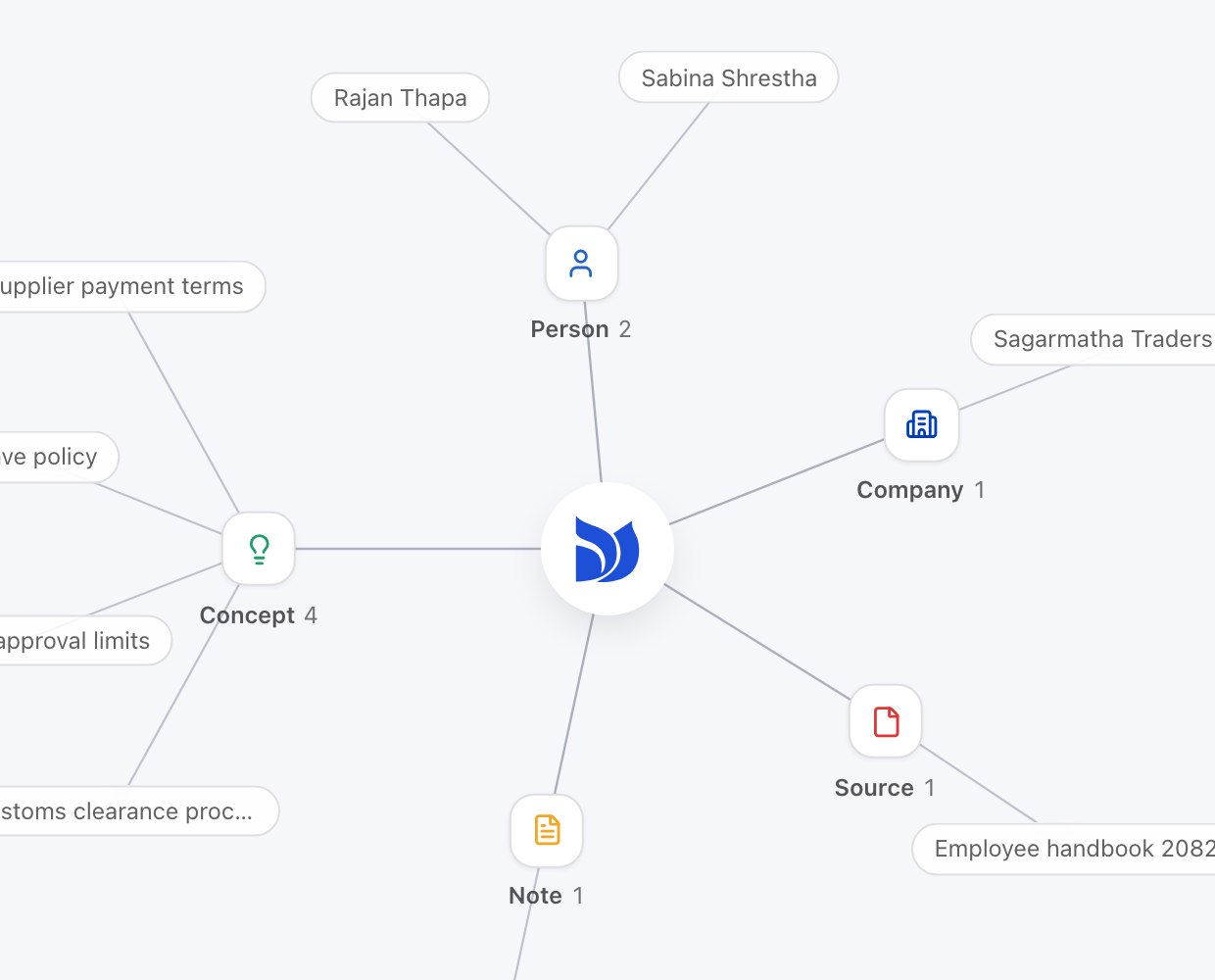
Brain shows what it knows as a graph, categories, the pages under them, and how they connect.
3. Link pages to each other
Pages link with [[double brackets]]. Link liberally, the leave policy to the
holiday calendar, the escalation process to the on-call rota. Links are how a
question that spans two pages gets a single coherent answer instead of two
fragments.
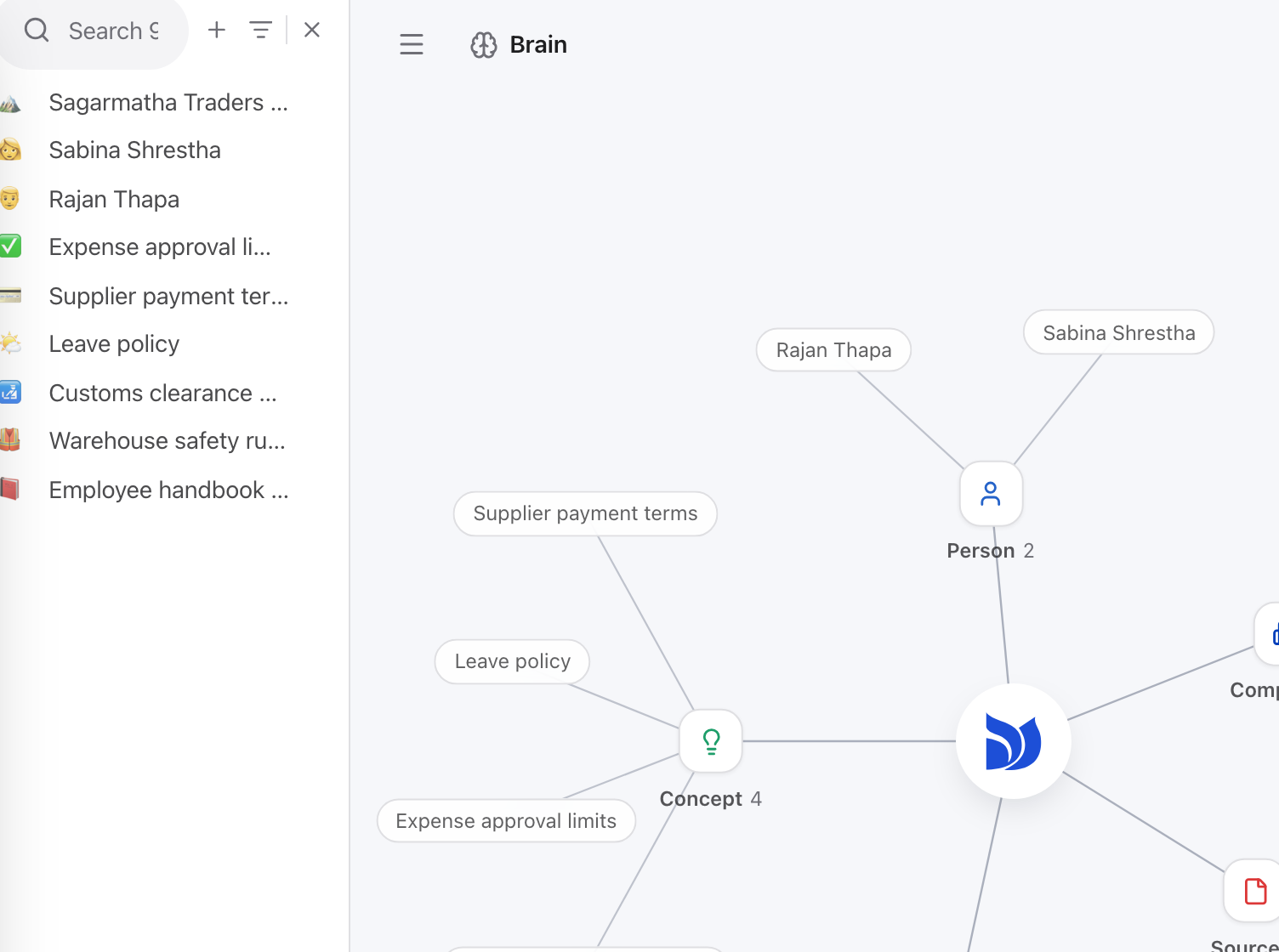
Pages are typed, company, person, concept, note, source, so retrieval can tell a policy from a person.
4. Ask it questions and watch the gaps
Now use it. In any task, ask something the brain should know. You get an answer, the pages it cited, and the gaps, what the brain did not have.
Treat the gap list as your writing queue. The loop is: ask, see the gap, write the page, ask again. This is the only reliable way to find out what your organisation never wrote down, and it takes days rather than the quarter a knowledge audit takes.
5. Connect it to the staff who need it
An AI staff member answering policy questions should be connected to the brain. One drafting marketing copy should not, an irrelevant knowledge base makes retrieval worse, not better.
6. Keep it true
A wrong page is worse than a missing one, because it will be cited confidently. When a policy changes, edit the page the same day. When a page is superseded, delete it rather than adding a note at the top.
What not to put in it
Anything private to one person. Brain is shared knowledge; personal drafts belong in your own space.
One worker’s habits. “Finance wants figures in lakhs” is a staff member’s memory, not organisational knowledge.
Live data. A brain page saying “current headcount: 47” is wrong within a month. Write where headcount lives, not what it is.
Next
- Company knowledgesearching, citations, and the grounding rule
- Hire your first AI staff memberconnecting staff to a brain